Ace Pool Elite
execl maroccoPuzzle
4.5843.00 Reviews
- Version
- 1.0.1.2
- Installs
- 1.00M
- Age Rating
- Mature 17+
Screenshots
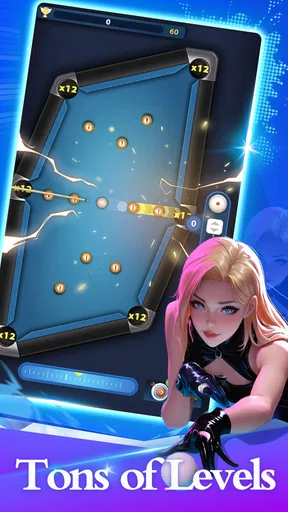
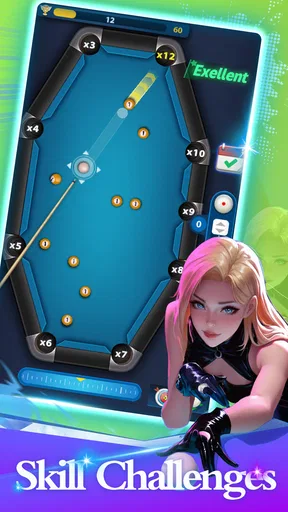
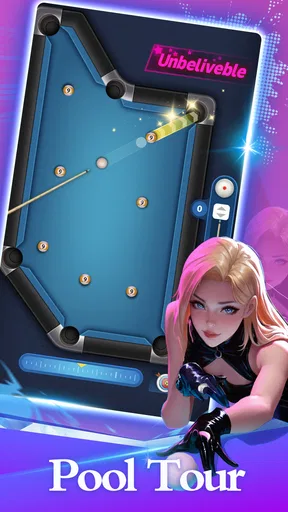


Our Review of Ace Pool Elite
 Analysis by Appyee
I approached Ace Pool Elite as a compact puzzle game built around one simple question: can I make the right shot with enough control to clear the table efficiently? Its store summary, “Precision in Every Strike!”, points to the central appeal, but the real test is whether that precision stays enjoyable after the first few rounds. In my experience, this is best understood as a focused pool challenge rather than a full social billiards package. It is free, belongs to the puzzle category, and is published by execl marocco.
The game has already attracted over a million installs, with an average rating of 4.5 from around thirteen thousand ratings and hundreds of written reviews. That gives it a useful sense of momentum, although popularity alone does not guarantee that its style will suit everyone. I found the strongest reason to try it is the short, repeatable nature of its play: it is easy to pick up for a few minutes, yet precise enough to reward patience.
How I built a reliable baseline routine
My first useful habit was to stop treating every shot as a quick tap. I took a moment to read the table, identify the easiest target, and think about where the cue ball would finish. That small pause matters in a puzzle-oriented pool game because sinking one ball is only part of the job. A shot that succeeds but leaves an awkward next position can make the following attempt much harder.
A practical starting routine is simple. I scan the available paths, choose the ball with the clearest route, line up the cue, and use only as much force as the shot needs. After each strike, I reassess instead of following a fixed order automatically. This makes the game feel less like random trial and error and more like a chain of small decisions.
That workflow is especially useful when I am playing during a short break. I can begin with a cautious attempt rather than needing a long session to understand the situation. If the opening shot goes badly, restarting my thinking process is quick. If it goes well, the next decision still feels meaningful because the position of the cue ball changes the available options.
I also learned not to chase the most ambitious shot immediately. A difficult bank or narrow angle may look satisfying, but a safer route often preserves more control. For new players, the best improvement is usually not stronger striking; it is choosing a shot that leaves a manageable follow-up. That principle carries through nearly every puzzle arrangement.
What to check before committing to a shot
Before striking, I look at three things: the target line, the likely cue-ball path, and the position of nearby balls. The first tells me whether the shot is realistic. The second helps me avoid accidentally placing the cue ball behind another obstacle. The third prevents a successful pocket from creating a worse problem immediately afterward.
This is where the game separates casual tapping from deliberate play. I do not need advanced pool knowledge to begin, but I do need to notice how one decision affects the next. Players who enjoy spatial puzzles will probably appreciate that extra layer. Someone looking only for instant arcade action may find the same pause slightly slow.
A useful everyday scenario is playing while waiting for an appointment. I can complete a few attempts without committing to a large campaign or a long multiplayer session. The short-cycle format makes it suitable for quick concentration practice, but it is also easy to replay a difficult situation repeatedly and lose track of time. I recommend setting a stopping point if you are using it as a brief break rather than as your main game.
Settings and controls worth checking early
I would begin by checking the available control and presentation options before judging the game too quickly. Small changes in sensitivity, aiming behavior, sound, or visual feedback can affect whether a shot feels precise or slippery. I avoid assuming that the default setup is ideal for every phone, because touch response and screen size change the experience considerably.
On a smaller display, I prefer slower, more deliberate movements rather than trying to drag quickly into position. On a larger screen, I can make finer adjustments with less accidental movement. If the controls feel imprecise, the first response should be to review the settings and adjust the way I hold the device, not to increase power blindly.
Sound settings are worth considering as well. Audio feedback can make a successful pocket feel clearer, but some players will prefer a quiet session in a public place. Since the game works well in short bursts, being able to make the presentation comfortable for the situation is more important than it may sound.
I also recommend checking the game after installing it on an older compatible device. The minimum operating system is Android 7.0, which makes the software accessible to a broad range of Android users, but an older phone may still respond differently from a newer one. Touch delay, screen scaling, and general smoothness can influence precision more than a player expects.
The current version is 1.0.1.2, so I would keep expectations realistic about the shape of the experience. This is not a reason to dismiss it; it simply means I judge the core shooting loop rather than expecting the depth of a long-established billiards simulation. For me, the important question is whether the basic controls remain understandable and repeatable, and they do once I slow down.
Repeatable patterns that make play faster
Experienced play in pool puzzle games is less about rushing and more about reducing wasted decisions. I use a repeatable scan: easiest pocket first, danger zones second, cue-ball landing third. Once that becomes automatic, I spend less time staring at the table and more time making useful adjustments.
Another effective pattern is to separate aiming from power. I line up the direction first, then choose the strength. Combining both actions in one hurried movement makes it harder to understand why a shot failed. Separating them gives me a clearer correction for the next attempt: either the angle was wrong or the force was wrong.
I also try to preserve a simple escape route for the cue ball. When two possible shots are equally attractive, I choose the one that leaves more open space afterward. This is a non-obvious advantage because the immediate pocket may look identical, while the next position can be dramatically easier. It is a habit that helps both beginners and players who already understand basic billiards geometry.
When a shot fails, I change one variable at a time. I may adjust the angle slightly while keeping the force similar, or keep the line and reduce the power. Repeating the same attempt with several changes at once teaches me very little. A controlled retry turns failure into information, which is exactly where the puzzle side of the game becomes most satisfying.
For quick sessions, I use a two-attempt rule on especially awkward positions. The first attempt tests the idea; the second applies a specific correction. If both fail for the same reason, I step back and choose a different route instead of forcing the original plan. This keeps the game from becoming a frustrating loop and helps me recognize when a clever-looking shot is simply not worth its risk.
Where the experience reaches its limits
The focused design is also the main limitation. Players who want a broad billiards package with a large competitive community, extensive customization, or a long progression structure may prefer a different type of game. Ace Pool Elite is more appealing when the pleasure comes from solving the immediate table rather than managing a large collection of modes.
I would also skip it if I dislike precision-based touch controls. Even when the objective is clear, small aiming errors can feel more important than they would in a loose arcade title. That is part of the challenge, but it means the game is not the best fit for someone seeking a completely relaxed, low-attention experience.
The mature 17+ content rating is another point to consider before recommending it to younger players. A parent should check the suitability of the game for the intended user rather than assuming that a puzzle label automatically means it is appropriate for every age group.
Compared with a traditional pool simulator, this game is easier to approach because I can focus on individual shots without needing to learn every rule or commit to a full match structure. Compared with a casual arcade pool game, it asks for more patience and planning. That middle position is its clearest identity: it offers billiards-inspired precision through a puzzle lens, but it may feel too restrained for players who want spectacle or fast competition.
It is also worth remembering that free access does not automatically make an app frictionless. I consider whether the play loop itself is strong enough to justify returning, rather than installing it only because there is no purchase at the start. For me, the replay value comes from improving decisions, not from expecting a large amount of content around them.
Who will get the most from it
I would recommend this game to someone who enjoys visual problem-solving, careful touch controls, and short sessions with a clear objective. It suits players who like practicing a skill and seeing a failed attempt become a better one. It can also work for a pool fan who wants something lighter than a full simulation but still wants positioning to matter.
I would be more cautious with the recommendation for players who mainly want online rivalry, elaborate progression, or constant novelty. Those users may find the concentrated format narrow after the initial appeal wears off. Likewise, if your phone’s touch response is inconsistent, you may blame the controls for mistakes that are actually caused by the device.
One benefit for newcomers is that the game gives them a reason to learn through repetition. I do not need to memorize complicated terminology before starting. I can improve by watching where the cue ball travels, comparing the result with my intention, and making a smaller correction next time. That makes the learning curve approachable even when the best shots require patience.
For returning players, the challenge is to replace instinctive force with deliberate placement. I get more consistent results when I treat every shot as part of a sequence instead of judging it only by whether the target ball disappears. That mindset is the most valuable lesson I took from the game, and it is also what keeps the simple format from feeling empty.
My verdict after settling into the rhythm
Ace Pool Elite works best when I play it as a precision puzzle, not as a complete replacement for every kind of pool game. Its free price makes trying it easy, and its broad install base and 4.5 average rating suggest that many players find the basic idea appealing. My own recommendation is positive, with the condition that you enjoy measured aiming more than frantic action.
The strongest approach is to check the controls, slow down the opening scan, separate direction from power, and learn from one changed variable at a time. Those habits make the experience more consistent without pretending that every shot can be solved instantly. They also reveal the game’s real strength: a small decision can change the entire sequence that follows.
My final advice is straightforward. Install it if you want a free Android puzzle game that turns pool shots into repeatable spatial challenges and you are comfortable with a focused format. Choose a broader billiards alternative if you need deep competitive features, a large variety of modes, or a more forgiving arcade feel. For the right player, this is a satisfying little practice ground where precision matters more than speed, and that is a worthwhile niche to fill.
Verdict
Strengths of Ace Pool Elite
- Realistic physics make aiming and shot selection feel satisfying.
- Multiple game modes offer variety beyond standard pool matches.
- Smooth controls make cue positioning easy on touchscreen devices.
- Competitive matches provide a strong challenge for experienced players.
- Clean visuals keep the table and ball positions easy to read.
Limitations of Ace Pool Elite
- Some advanced features may require in-app purchases.
- Online competition can feel difficult for new players.
- Matches may become repetitive after extended sessions.
- A stable internet connection may be needed for multiplayer.
- Ads can interrupt the experience in the free version.
Other Releases by execl marocco
View All
8 Ball Kick
Puzzle4.5
Similar Picks in This Category
View All
Block Blast!
HungryStudio4.8

Braindom: Brain Games Test
Lahana Game Studio4.6

AMAZE!
CrazyLabs LTD4.6

Sudoku - Classic Sudoku Puzzle
Oakever Games4.7

Art Puzzle - Puzzle Games
Easybrain4.8

Amaze GO!
Oakever Games4.9
Frequently Asked Questions
What is Ace Pool Elite, and how does the game work?
Ace Pool Elite is a mobile pool game focused on competitive billiards matches, precision shots, and progression through different challenges. After installing it, players can practice aiming, control shot strength, and compete in matches designed to test accuracy and strategy. The experience is intended for both casual players and pool fans who enjoy improving their skills over time.
Is Ace Pool Elite free to download and play?
Ace Pool Elite can generally be downloaded without an upfront purchase, although the exact availability and pricing may vary between Android and iOS. Like many free-to-play sports games, it may include optional in-app purchases for items, upgrades, currency, or other gameplay benefits. Players should review the store listing and purchase settings before downloading, especially if the device is shared with children.
Does Ace Pool Elite require an internet connection?
Some features in Ace Pool Elite may require an active internet connection, particularly online matches, account synchronization, leaderboards, advertisements, or event-based content. Practice or selected single-player activities may work with limited connectivity, but offline access can vary depending on the version and device. For the most reliable experience, use a stable Wi-Fi or mobile data connection.
Is Ace Pool Elite suitable for beginners?
Ace Pool Elite is approachable for beginners because the basic controls are easy to understand: aim the cue, adjust the power, and take the shot. However, becoming consistent requires practice, since positioning the cue ball, controlling force, and planning several shots ahead can be challenging. New players should begin with practice modes or easier matches before entering more competitive gameplay.
What should I check before downloading Ace Pool Elite?
Before downloading Ace Pool Elite, check that your Android or iOS device meets the minimum operating-system requirements and has enough free storage for the installation and future updates. It is also worth reviewing the permissions requested, privacy information, online requirements, advertising, and in-app purchase details. Availability of features may differ by region, device model, and app version.
Play our best games!


